
Enjoy Ski · Wellness Capsule
The proposition is unusually easy to describe, which is part of why it has spread so fast. You lie down in a scanner. About an hour later you get up, and somewhere in the building a radiologist begins reading several thousand images of your insides.
Most people in the United States first heard this from Neko Health, which opens in New York this autumn with more than 350,000 people on its list. Switzerland has been doing a longer and more detailed version of it for a while, and you can book it for next month.
What follows is what the appointment actually involves, what the report will and will not tell you, and the practical business of arranging a trip around a date you cannot move.
The appointment
What the Hour Consists Of
Take Revoscan in Geneva as the worked example, because it publishes its numbers plainly.
Revoscan · Geneva
- Sixty minutes in the whole-body MRI
- Six to seven thousand images produced in a single session
- No radiation — this is magnetic resonance, not a CT of the whole body
- A broad blood panel: cardiovascular, metabolic, liver and kidney markers, plus hormones and toxicity
- A cardiac CT with calcium score, and a bone density measurement
- Preliminary results the same day; full report and a private one-to-one consultation within seven days
- The blood draw can be done at your home or hotel rather than at the clinic
Two of those details tell you what kind of clientele this is built for. The same-day preliminary read is one. The blood draw at your hotel is the other — it means the appointment itself stays inside a single morning, rather than sprawling across two.
The seven-day gap before the full report matters more than it sounds, and we will come back to it.
Aeon · several Swiss cities
- Ninety-minute appointment across all three tiers
- Entry tier: whole-body MRI, twenty-two blood biomarkers, online report
- Top tier adds genetic analysis and a longevity consultation
- Described as covering over five hundred possible anomalies across brain, organs and vessels
- Results within five working days or less, with a doctor talking you through them in every package
Ahead Health · membership model
- Structured as a membership rather than a single visit: regular blood testing, imaging layered on
- Twelve organ systems assessed in one MRI, including brain, spine, heart and liver
- Blood work runs to eighty-plus biomarkers
- Report within a few business days, with risk assessments and an action plan
- Unusually, they state that several Swiss supplementary insurance plans contribute to the cost, KPT among them — reimbursement varies by plan, so this is a question for your insurer rather than an assumption
Others operate on the same model — 360Prevent in Zurich and Bern, Arvin elsewhere in the country. The differences between them are real but narrow: how long you are in the machine, how much blood work comes with it, and how quickly a human being explains the result to you.
The part the brochures skip
What a Scan Cannot Do
A whole-body MRI is a screening tool, not a diagnosis, and screening healthy people is a genuinely contested subject in medicine. The published picture looks like this:
- The American College of Radiology said in 2023 that the evidence was insufficient to recommend whole-body screening for people without symptoms, risk factors or a family history pointing at something specific
- In asymptomatic adults, reviews put cancer detection at roughly one to two per cent
- The proportion who come away with some finding is very much higher — and the overwhelming majority of those turn out to be nothing at all. Radiologists call them incidentalomas
- One cohort study found elevated healthcare use and cost for at least two years afterwards, driven largely by chasing findings that proved benign
The clinics selling the scans are, of course, aware of this, and the good ones will say so if you ask.
None of which makes the scan a bad idea.
It makes it a decision with two sides, and one you should take with a doctor who knows your history rather than with a travel company. If you are the sort of person who will worry productively about an ambiguous result, this is a good use of an hour. If you are the sort who will worry unproductively, that is worth knowing about yourself before you book.
Planning around it
Four Practical Notes
One
Do not scan on your arrival morning.
An hour of lying still after a transatlantic flight is not the same hour it would have been after a night’s sleep. Give yourself a day in the city first. It also protects the appointment against a delayed flight, which is the failure mode that actually happens.
Two
The report will reach you after you have left.
Five to seven days is standard. On a week’s trip, that means the consultation happens while you are in the mountains or already home. Ask at booking whether the follow-up can be done by video, and whether they will send the imaging to your own physician.
Three
Ask what happens to the images.
You are commissioning several thousand pictures of your own body in a foreign country. Who holds them, in what format you can take them away, and whether your doctor at home can open the file are all reasonable things to establish before the appointment rather than after.
Four
Book the mountains around the clinic, not the reverse.
Scanner slots are the fixed point; chalets and hotels are not. Get the appointment confirmed, then build the week outwards from it. Which resorts sit within reach of which city →
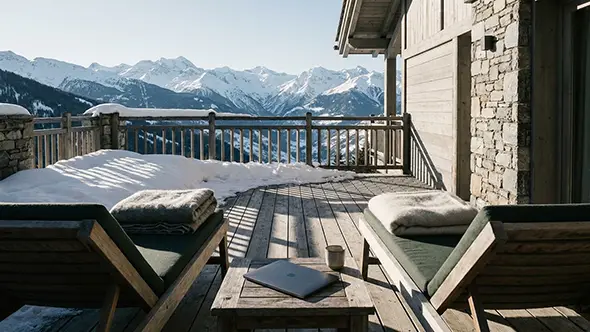
One last distinction, since the two get conflated constantly. This is measurement. It produces a document. It does not make you feel any different, and it is not designed to — that is a separate proposition, and it lives about two hours away in a hotel in Appenzell.
The circuit of chambers, and what it is actually for →
Once the date is fixed
We work backwards from it
Enjoy Ski does not book clinics and does not give medical advice — that is between you, the provider and your physician. What we do is the week around it: where to stay the night before, the transfer up the valley afterwards, the chalet at the other end.
Browse Swiss hotels and chalets →
WhatsApp: +370 693 73577
Email: welcome@enjoy-ski.com
This piece is part of Wellness Capsule, a short series on what Swiss health travel has turned into and how to build a week around it.