
Alps Transfers 2025/2026 — Helicopter Door-to-Door vs Last-Minute Options
Winter 2025/2026 promises to be one of the busiest in the Alps’ history. Milan-Cortina 2026 Olympics, school holidays, Davos World Economic Forum, and growing tourist flows put heavy pressure on already overloaded infrastructure. Roads A22 Brenner, A40/A41, and A43 are operating at their limits.
Airports Geneva, Chambéry, and Zurich face a severe shortage of business jet slots — rejection rates reach 50% in January. In such conditions, getting to your chalet becomes a real strategic challenge.
Early booking (minimum 6 months in advance) opens access to helicopter or altiport transfers directly to the door. Last-minute options remain comfortable — premium cars or shuttles are still better than hours in traffic jams.
Traffic Jams in the Alps — Why Personal Car in 2026 Will Become a Nightmare
Alpine corridors are among the most congested in Europe. The A22 Brenner route is particularly critical — the main gateway to the Dolomites from Germany, Austria, and northern Italy.
According to Autostrada del Brennero and Eurac Research Center in Bolzano:
-
- average daily traffic in 2024 — about 46,000 vehicles per day
-
- growth since 2012 — +22%
-
- forecast for 2026 — approximately 57,000 vehicles/day
In peak days (weekends, holidays, Olympics) the flow jumps to 48–50 thousand vehicles per day. This is already close to the capacity limit of a two-lane highway.
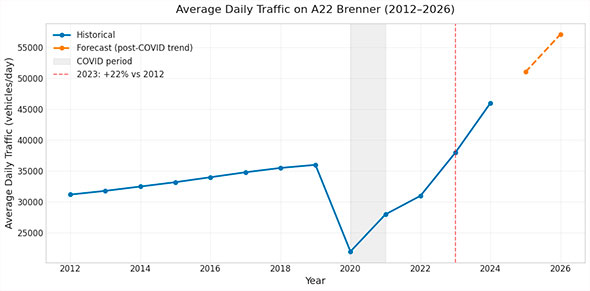
What the chart shows: The line chart displays average daily traffic on A22 Brenner from 2012 to 2026. Blue line — historical data, orange dashed line — post-COVID trend forecast. Gray background — COVID period, red vertical line — 2023 mark (+22% vs 2012).
Conclusions: Traffic has been steadily growing for over 10 years, with faster recovery after COVID. By 2026, average daily traffic will exceed 55,000 vehicles/day — meaning peak days will push the road to its limit, with 4–6 hour delays becoming normal. Ground transfer without alternatives — high risk.
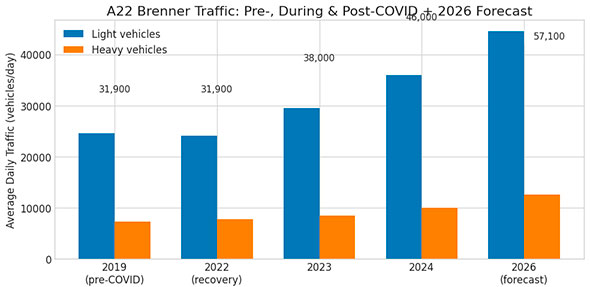
What the chart shows: The bar chart shows average daily traffic on A22 Brenner in 2019 (pre-COVID), 2022 (recovery), 2023, 2024, and forecast for 2026. Blue bars — light vehicles, orange — heavy.
Conclusions: Traffic fully recovered by 2022 and already exceeds pre-COVID levels. By 2026, ~57,000 vehicles/day expected, with ~45,000 being light vehicles. Main load — from tourists and Olympic attendees, while heavy transport adds constant baseline congestion. Old forecasts are outdated — the road will be even more congested.
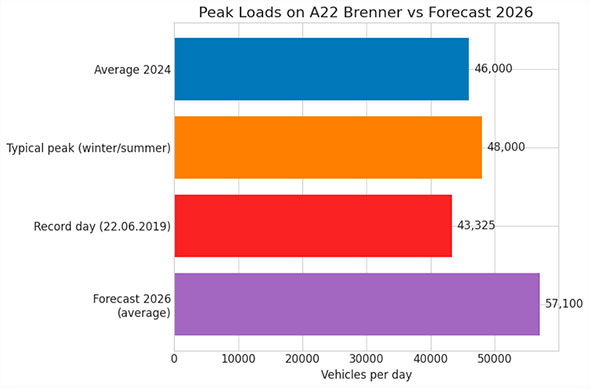
What the chart shows: Horizontal bars compare average traffic 2024 (46,000 vehicles/day), typical peak (48,000), record day 2019 (43,325), and forecast 2026 (57,100).
Conclusions: Average traffic in 2026 will be close to what is now considered a peak. Any accident, snow, or mass arrival for the Olympics will cause multi-kilometer jams. Personal car ground transfer — unreliable option for 2026.
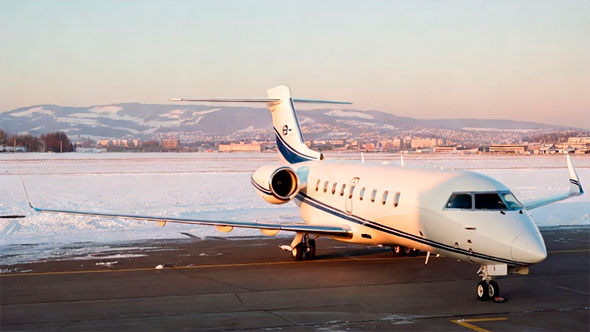
HelicopterS & Altiport — Fastest Way to Reach Your Chalet
In the premium segment, helicopter or light aircraft to an altiport is a necessity. These landing sites allow completely bypassing traffic jams and dropping guests almost at the chalet door.
Courchevel Altiport (LFLJ)
- Transport type: helicopters (any), light fixed-wing (PC-12, Caravan)
- Altitude: 2008 m
- Time to chalet: 5–10 minutes
- Final transfer: electric car or vehicle (5–15 min)
- Features: highest altiport in Europe, commercial fixed-wing charters prohibited
Meribel Altiport
- Transport type: helicopters, light fixed-wing
- Altitude: 1710 m
- Time to chalet: 5–10 minutes
- Final transfer: electric car or vehicle (5–15 min)
- Features: convenient access to Three Valleys
Val Thorens Altiport
- Transport type: helicopters only
- Altitude: 2300 m
- Time to chalet: 5 minutes
- Final transfer: electric car or vehicle (5 min)
- Features: highest in Europe
Samedan (SMV) — St. Moritz
- Transport type: business jets (up to Falcon 7X/G700), helicopters
- Altitude: 1707 m
- Time to chalet: 10 minutes
- Final transfer: car or electric car (10 min)
- Features: highest jet airport in Europe
Zermatt Heliport
- Transport type: helicopters only
- Altitude: 1600–1800 m
- Time to chalet: 0–5 minutes
- Final transfer: on foot or electric car
- Features: car-free resort, helicopter is the only way to the center
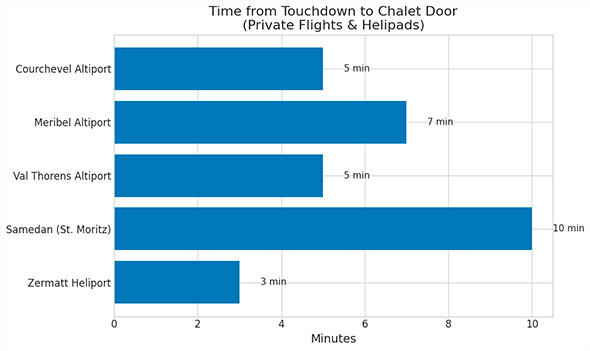
What the chart shows: Horizontal bars display average time from landing (helicopter or light aircraft) to chalet door for key sites: Courchevel, Meribel, Val Thorens, Samedan, Zermatt.
Conclusions: Fastest transfer — Zermatt (3 min) and Val Thorens (5 min). Average — 5–10 minutes. This is 10–30 times faster than ground transfer. Early helicopter booking guarantees arrival without traffic.
Slot Shortage in Geneva and Chambéry — Why Book Jet 6 Months in Advance
In January 2026, Alpine airports become a bottleneck for business aviation. Olympics, school holidays, Davos Forum, and peak ski season create record demand.
Main hubs:
-
Geneva (GVA) — main for French Alps and part of Switzerland, strict curfew
-
Chambéry (CMF) — bottleneck for Three Valleys
-
Zurich (ZRH) — for eastern Switzerland and St. Moritz
According to business aviation operators (Lunajets, Paramount Business Jets, Just Aviation), slot rejection rates reach 30–50% in January 10–20, 2026 if booking less than 6 months ahead.
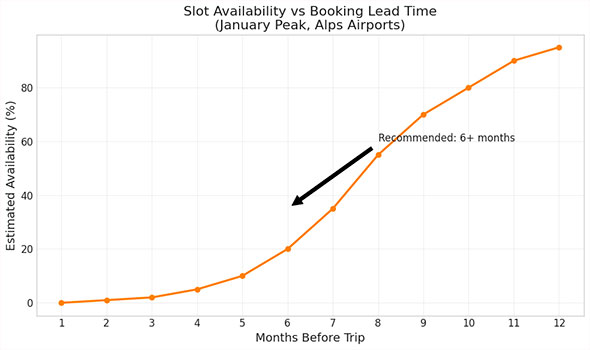
What the chart shows: Line chart displays estimated slot availability in % depending on booking time (1 to 12 months before trip). Orange line — trend, arrow — recommended 6+ months.
Conclusions: Availability drops sharply: 6+ months — 35–40%, 1–2 months — almost 0%. Last-minute jet booking in January is nearly impossible. Recommend booking slot together with chalet.
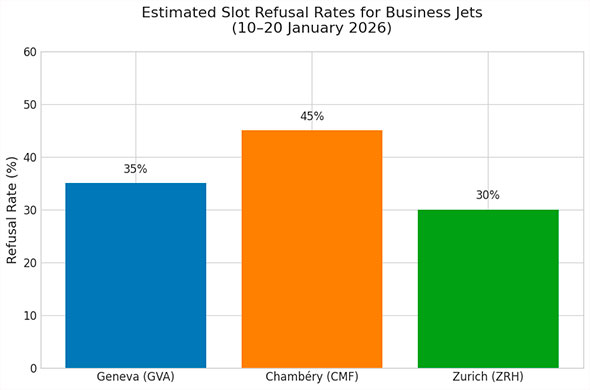
What the chart shows: Bar chart shows percentage of slot refusals for business jets in key airports: Geneva (~35%), Chambéry (~45%), Zurich (~30%).
Conclusions: Chambéry is the tightest bottleneck for Three Valleys (Courchevel, Meribel, Val Thorens). Geneva and Zurich also highly competitive. Without early booking (6+ months), refusal probability is very high — better prepare backup airports (Lyon, Grenoble, Milan).
Weather Risks — Helicopter Is Not Always 100% Guarantee
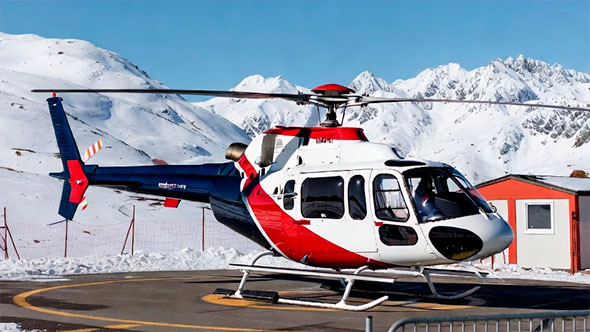
Alps in January — short daylight, low clouds, strong winds, and frequent valley fog. Helicopters operate only under VFR rules (visual flight), so bad weather can cancel the flight.
According to operators (Alpes Helico, Air Zermatt, Blade):
-
in January about 40–60% of days can be non-flyable for helicopters due to fog, snow, or wind
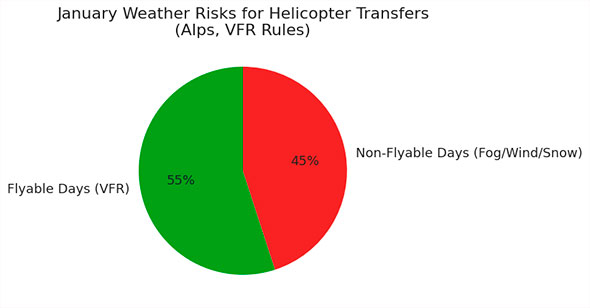
What the chart shows: Pie chart shows the share of January days suitable for VFR flights (55% — flyable) and non-flyable (45% — due to fog, wind, or snow).
Conclusions: Almost half of January in the Alps carries risk of helicopter cancellation. This means plan B (premium car on standby) is mandatory. Top operators always duplicate helicopter with a vehicle — Range Rover or Mercedes V-Class waits at the airport.
Last-Minute Transfer to Courchevel and Dolomites 2026 — Working Options
Not everyone manages to plan a trip six months in advance. Many decide to fly at the last moment — due to spontaneous decisions or changes in plans.
Alternative airports with more available slots:
-
Lyon (LYS) — 2–3 hours to Three Valleys.
-
Grenoble (GNB) — 1–2 hours to Val d’Isère, Alpe d’Huez.
-
Milan Malpensa (MXP) or Bergamo (BGY) — 2–4 hours to Italian Alps.
-
Turin (TRN) — 1.5–2.5 hours to Courmayeur and Cervinia.
Ground options:
-
Shared luxury shuttle — Mercedes V-Class or Sprinter, Wi-Fi, drinks, ski storage (booked 24–48 hours in advance).
-
Private transfer — Range Rover, Mercedes S-Class or V-Class, door-to-door.
-
Train + shuttle — Bernina Express to St. Moritz or TGV to Moutiers with onward transfer.
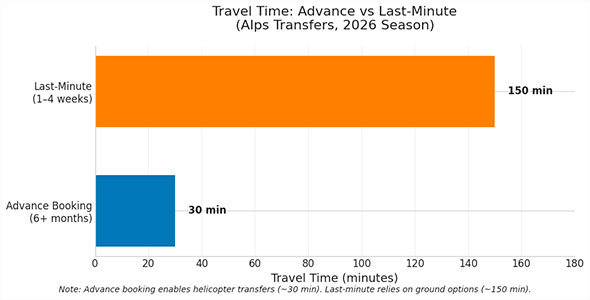
What the chart shows: Horizontal bars compare travel time for early booking (30 min by helicopter) and last-minute (150 min by ground transfer).
Conclusions: Last-minute is a time compromise: instead of 30 minutes by helicopter — 2.5 hours by premium car or train. But comfort remains high, and reliability — 100%. Better than hours stuck in traffic on A22 or A40.
Premium Ground Transfer — Extension of Your Chalet on Wheels
Even if helicopter is unavailable, ground transfer in the Alps is far from regular taxi. In the 2025/2026 season, premium standards include:
-
- Cars Mercedes S-Class/V-Class, Range Rover Autobiography, Porsche Cayenne or Maybach.
-
- Starlink — high-speed satellite Wi-Fi (up to 200–500 Mbps).
-
- Multimedia — screens for kids, Apple TV, premium audio Bose/Burmester.
-
- Meet & Greet — meeting at aircraft door, fast-track passport/customs, porters for luggage.
-
- Personalized drinks/snacks, iPad climate control, child seats.
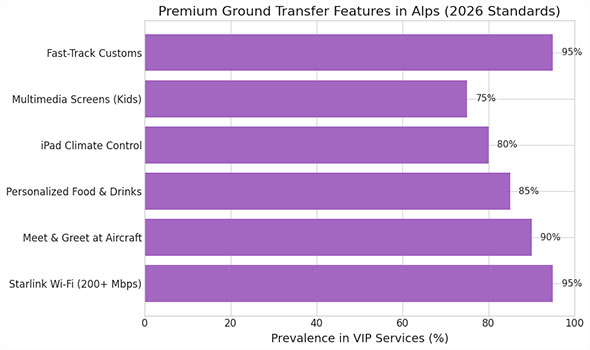
What the chart shows: Horizontal bars show the percentage of key premium features in VIP transfers: Starlink Wi-Fi (95%), Meet & Greet (90%), personalized drinks (85%), etc.
Conclusions: Almost all operators offer Starlink, Meet & Greet, and fast-track. This means ground transfer is a full extension of your holiday: guests get a “living room on wheels” with Wi-Fi, drinks, and comfort that matches the chalet.
Frequently Asked Questions
How long does a helicopter transfer to Courchevel take?
From 5 to 10 minutes from landing to chalet — depending on the altiport.
What to do if no slot in Geneva for January 2026?
Fly to Lyon, Grenoble, or Milan Malpensa/Bergamo. From there — premium shuttle or private van (2–3 hours).
Can you fly a helicopter in the Alps in bad weather?
Helicopters operate only under VFR — fog or strong wind cancels the flight. Always have plan B — premium car.
Which transfer to choose for last-minute trip?
Shared luxury shuttle or private van from Lyon/Grenoble — 2–3 hours, comfortable and reliable.
How much does a helicopter transfer to the Alps cost?
Price depends on distance, number of passengers, and season — from €2,000–4,000 per flight (4–6 people). Exact quotes on request.
Can I combine helicopter and ground transfer?
Yes, many clients combine: helicopter to altiport + premium car to chalet. Ideal for flexibility and plan B.
Summary — Who Should Choose Which Transfer
Early booking (6+ months) — helicopter or altiport directly to chalet. Perfect for VIP guests, sponsors, and those who value time.
Last-minute — premium car or train. 2–3 hours, but comfortable and reliable. Better than hours in traffic.
Plan B — always duplicate helicopter with a car. This is the highest level of care.
At Enjoy-Ski we help with any scenario — from exclusive helicopter flights to last-minute shuttles.
The main thing — don’t leave it until the last minute.
Or write to us: welcome@enjoy-ski.com
Data and Analysis Sources
All figures, forecasts, and conclusions in the article are based on current reports and studies from 2012–2025. We used:
-
Autostrada del Brennero S.p.A. — annual traffic reports for A22 Brenner
-
Eurac Research (Bolzano) — monitoring of traffic and load growth on A22 since 2012
-
BrennerLEC (EU project) — data on VSL and impact on traffic/emissions
-
iMONITRAF! Annual Report 2023 — traffic recovery after COVID
-
Lunajets, Paramount Business Jets, Just Aviation — slot statistics for GVA, CMF, ZRH
-
Alpes Helico, Air Zermatt, Blade — weather restriction data for helicopters
Analysis and forecasts by Enjoy-Ski for the 2025/2026 season are based on these sources and our own experience in organizing transfers.